Wall covering
Wall covering and wallpaper hanging in Chicago homes and businesses
Wallpaper and wall coverings hung as part of the same job as the paint, so the decisions for a room are made once, with one team. Here is how a good paper job is built and how to keep it flat.
Chapter 01
Where wallpaper fails: open seams, bubbles and a pattern that drifts
Most wallpaper complaints trace back to three faults that show up within weeks. Seams open a hair at the edges and reveal the wall colour underneath. Bubbles rise where paste dried unevenly or air stayed trapped behind the sheet. And the pattern slowly drifts out of register, so a damask that lined up cleanly on the first wall is half a motif off by the time it meets the corner.
None of these is bad luck. An open seam usually means the wall was dusty or unprimed and the paper never bonded, or a strip was stretched while wet and shrank as it dried. A bubble that stays after drying is a paste or prep problem. Drift at a corner is a layout problem, and it gets solved before the first strip goes up, by deciding where the pattern will break and where it must not.
Corners are where a room tells the truth. Very few walls in a Chicago building are perfectly plumb, and decades of settling leave their mark, so a strip hung to the ceiling line will lean. The fix is a plumb line for every wall, a pattern that is allowed to turn the corner by a few millimetres rather than fight it, and a crew that checks the match before the paste dries.
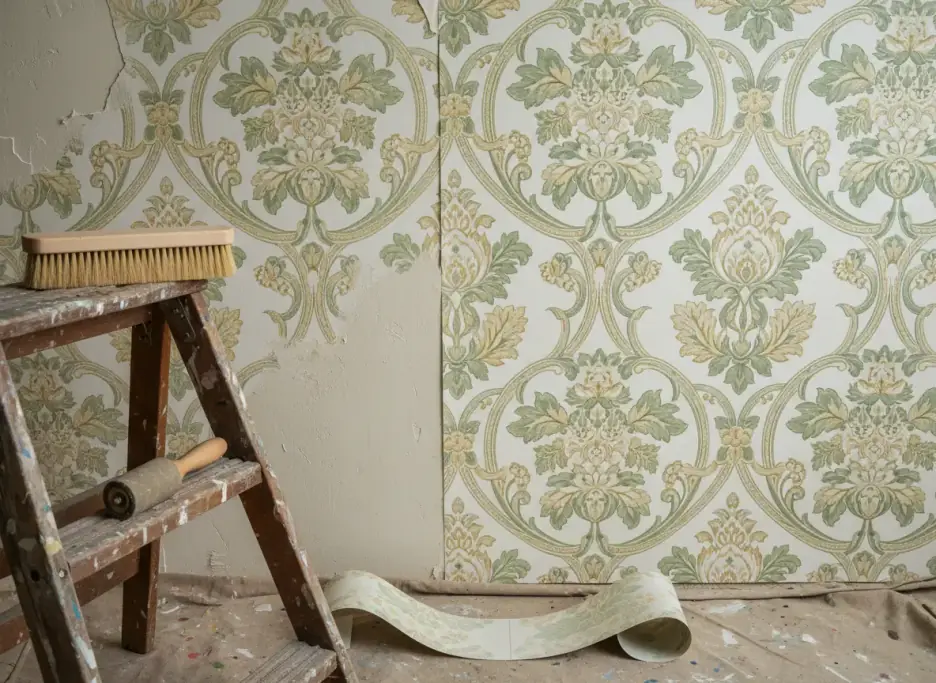
Damask wallpaper with a matched seam beside a step ladder holding a smoothing brush
How a wallcovering job runs: prep, primer, plumb line, matched seams
The wall decides the result before any paper is cut. Surfaces are sanded and patched, dust is wiped off, and a primer or sizing coat goes on so the paste grips evenly and the paper can still be slid into place while it is wet. Paper hung over bare patched plaster soaks up paste unevenly, which is where flashing and bubbles start. Skipping the primer saves an hour and costs the paper.
Layout comes next. The crew finds the visual centre of the main wall, snaps a plumb line and works outward from it, cutting strips from the same run in order so the pattern matches across every seam. Seams are butted tight, smoothed from the centre toward the edges and rolled lightly, never pressed hard enough to squeeze out paste and burnish the print. Excess paste comes off the face as each strip goes up.
Edges finish the job. Where a paper carries an untrimmed selvedge, that margin is cut away with a sharp blade and a straightedge, and corners, outlets and trim get a clean, tight cut. Walldecor also paints, so ceilings and trim can be handled as part of the same job as the paper. Ask the crew whether old paper has to come off first, since the answer depends on what is underneath.
Chapter 03
Aftercare: humidity, cleaning by paper type and spare rolls
Paper is happiest in a steady room. Steam from a shower or a kettle, a damp basement wall or a window that sweats all winter will lift seams over time, so bathrooms and kitchens need an exhaust fan that actually runs and a covering chosen for the humidity. Chicago swings from dry heated air in January to sticky July, and a wall covering that is allowed to expand and settle slowly outlasts one that is shocked by sudden change.
Cleaning depends on the paper. A vinyl-coated covering tolerates a damp cloth and mild soap. A standard printed paper usually wants only a dry soft brush or a barely damp sponge, and grasscloth or a textile covering should not meet water at all. Check the label or ask the crew which type is on your wall before you reach for a spray bottle.
Keep spare rolls. Ask for leftover paper from the same run to be left with you, labelled and stored flat and dry, because a reorder years later can come from a different dye lot and never quite match. A strip or two on hand makes a patch after a leak or a moved appliance nearly invisible. To talk through a room, call (773) 960-2273 and describe the walls.
Walldecor Incorporated is a professional team of painters serving business and residential clients across Chicago and the surrounding areas.