Spray-finished cabinets
Spray-finished kitchen and built-in cabinets in Chicago
Cabinet doors and boxes sprayed rather than brushed, for an even, factory-smooth coat on kitchens and built-ins. Here is what separates a finish that lasts from one that chips.
Chapter 01
Why cabinet finishes fail: brush marks, grease and chipped door edges
Cabinets live a harder life than walls. They are touched with greasy hands, wiped down daily, steamed by the dishwasher and knocked at the door edges a hundred times a week. A finish that looks fine on installation day shows its weakness within a year if the prep or the coat was wrong.
Brush and roller marks are the most visible failure. Even a good brush leaves ridges that catch the light across a flat door, and rolled paint carries a stipple that never looks like a factory panel. Spraying lays the coat on thin and level, which is why sprayed doors read as one smooth sheet rather than a painted surface.
The hidden failure is grease. Kitchen cabinets near the stove carry a film of cooking oil that paint cannot grip, and a coat applied over it peels in sheets, usually first at the door edges and around the handles where hands land. Chipping at edges also comes from coats applied too thick, or recoated before the layer below had cured. A proper job deals with all three before the first pass of the spray gun.
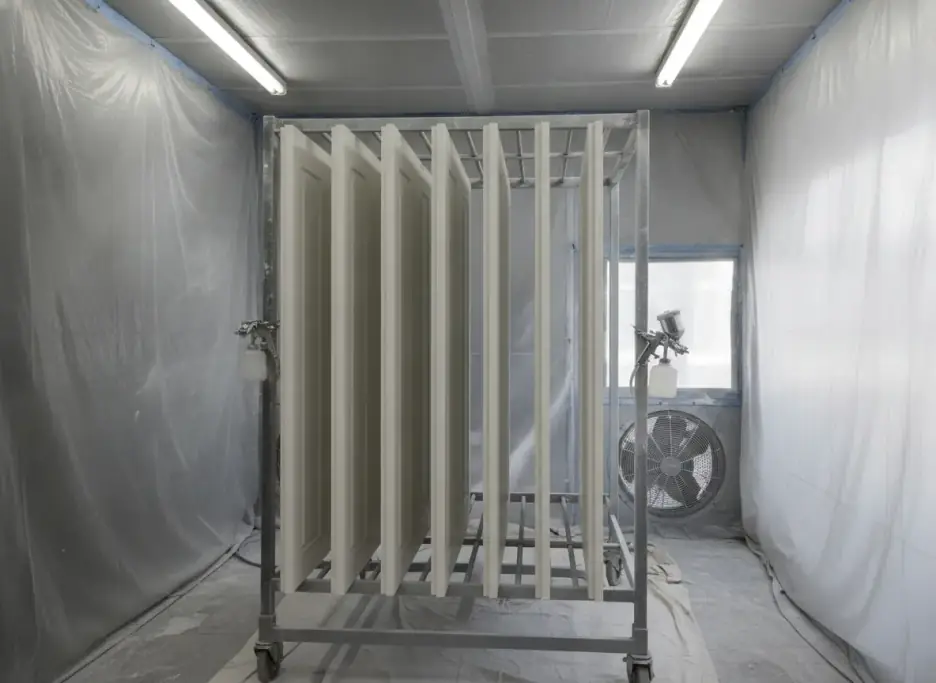
Cabinet doors in a satin off-white finish standing on a drying rack in a spray booth
How a spray job runs: doors off, degrease, sand, spray, cure
A sprayed cabinet job starts with taking things apart. Doors and drawer fronts come off the boxes, hinges and pulls are removed and bagged by position, and each door is marked so it returns to its own opening. Boxes that stay on the wall are masked, and floors, counters and appliances are covered, because a fine mist travels further than most people expect.
Then comes the surface. Every part is degreased with a proper cleaner, sanded so the finish has something to bite, and any dents or open grain are filled. Raw wood and glossy factory finishes need different primers, and a bonding primer under the colour is what keeps a coat from peeling off the edges later. Dust is removed before each coat, since a single speck becomes a bump in a sprayed surface.
Spraying itself is several thin coats rather than one heavy one, with time between coats so each can flash off. Doors are laid flat or hung to dry, and the finish then needs real time to cure before anything is handled and rehung. Ask the crew where the doors will be sprayed and how long they will be away from your kitchen, since both depend on the job.
Chapter 03
Aftercare: the cure window, gentle cleaning and soft-close bumpers
A sprayed finish feels dry long before it is hard. Lacquer and enamel keep curing for days or weeks, and during that window the surface marks easily. Go light: no dishes stacked against fresh doors, no adhesive hooks, no taped notes and no scrubbing. Ask the crew how long to wait before normal use, because it depends on the coating that was chosen.
After the cure, cleaning is simple. A soft cloth with warm water and a drop of mild dish soap handles splashes and fingerprints, followed by a dry cloth. Skip abrasive pads, ammonia sprays and anything sold as a heavy degreaser, since those dull a finish that was meant to stay smooth. Wipe up grease near the stove as it happens, not at the end of the month.
Small parts protect the paint. Clear soft-close bumpers on the door corners stop a cabinet slapping against its frame, which is where edge chips begin, and tight hinges keep doors from rubbing at the corners. Check them every few months and replace any that fall off. If a spot of paint does lift, call (773) 960-2273 so it can be touched up early.
Walldecor Incorporated is a professional team of painters serving business and residential clients across Chicago and the surrounding areas.